
Horned Guan
Oreophasis derbianus · Chiapas, Mexico
| Scientific name | Oreophasis derbianus |
| Conservation status | Endangered (IUCN) |
| Range | Chiapas, Mexico & highlands of Guatemala |
| Elevation | 2,300 m – 3,350 m |
| Best months | Year-round; most vocal February – May |
| Difficulty | High — steep hiking required |
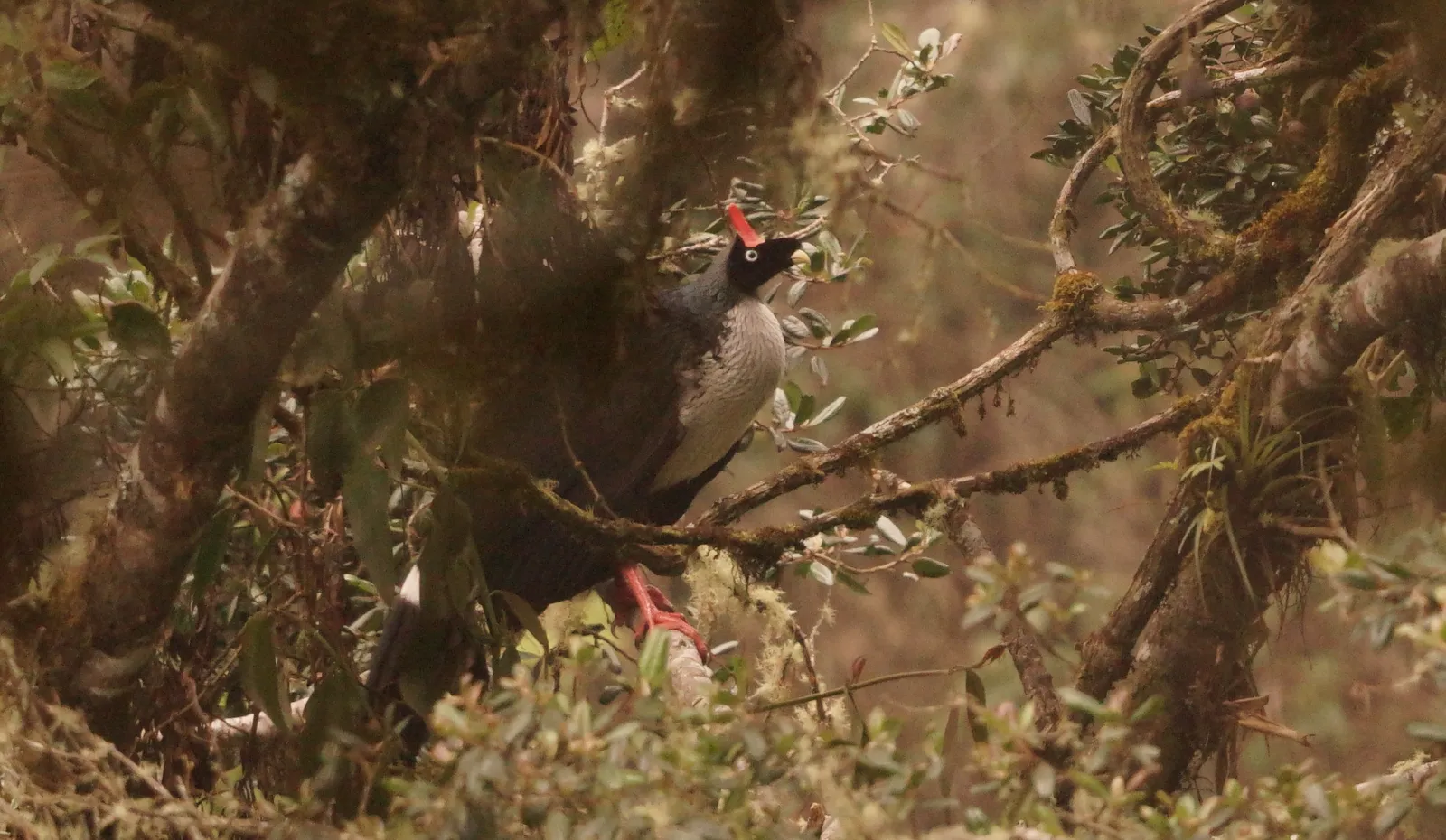
A large black-and-white cracid with a bizarre bright red "horn" emerging from its forehead, the Horned Guan is one of Chiapas's most vulnerable birds. Found only in the state's high-altitude cloud forests on slopes predominated by oaks, witch-hazels, and dendropanax, it is classified as Endangered by the IUCN. Fewer than 2,000 individuals remain as a result of habitat destruction and hunting. Its preference for steep slopes makes finding this species a physical challenge, requiring intense hiking and good knowledge of local flora.
Identification
Completely unmistakable. If you are looking at a large black-and-white cracid with a bright red horn, you've found a Horned Guan. Females and juveniles are told apart by their smaller horn, which emerges at four months. The unique appearance is due in part to its particular lineage within the Cracidae family, having separated from other members of the family some 20 million years ago and evolved independently ever since. Birds may move in pairs, but groups of up to ten individuals feeding at a single site have been observed.
Distribution and habitat
The Horned Guan is known to occur in Chiapas and Guatemala, with some suggestions it may also occur in Oaxaca and parts of Honduras. Its global range covers under 7,000 km², making it one of the most range-restricted cracids in the Americas. Within Chiapas, the only reliable sites are the high-altitude forests of the El Triunfo Biosphere Reserve and the upper slopes of Tacaná Volcano.
Seasonality and finding the species
The Horned Guan is a year-round resident, believed to remain within established territories. Breeding season at Tacaná can begin as early as late December, while at El Triunfo it runs from February to March during periods of low rainfall, with nests reportedly built in the mid-canopy — though records remain rare.
Conservation
With fewer than 2,000 mature individuals remaining, this species is teetering on the edge, especially here in Chiapas. Both El Triunfo and Tacaná Volcano are now considered biosphere reserves by Mexico's national parks authority, which should aid its protection to some degree.
The Horned Guan is the flagship target species on our Tacaná Volcano expeditions, and a key draw on multi-day bespoke itineraries into the highlands of Chiapas.
See our Chiapas birding toursSources
- BirdLife International (2024). Species factsheet: Horned Guan Oreophasis derbianus. datazone.birdlife.org
- Hoyo, J. and G. M. Kirwan (2020). Horned Guan (Oreophasis derbianus), version 1.0. In Birds of the World (J. del Hoyo, A. Elliott, J. Sargatal, D. A. Christie, and E. de Juana, Editors). Cornell Lab of Ornithology, Ithaca, NY, USA. doi.org/10.2173/bow.horgua1.01