
Published
Team: Ben (Cardellina Birding), Valente Gonzalez (Cardellina Birding), Sergio Gomez (expert bander), Renée (local guide, Chiquihuites)
🔗 eBird checklists: 1 · 2 · 3 · 4 · 5 · 6 · 7 · 8 · 9 · 10 · 11 · 12 · 13 · 14 · 15 · 16
A video trip report will be available soon on the Cardellina YouTube channel.
Mission Targets
Horned Guan · Black-capped Siskin · Buffy-crowned Wood-Partridge · Fulvous Owl · Stygian Owl · Unspotted Saw-whet Owl · Pink-headed Warbler · Wine-throated Hummingbird
Key Locations
- Chiquihuites village and surrounds (~2,100–2,300 m)
- Camino al Cráter, Tacaná (upper trail, ~2,500–3,000+ m)
- Camino Talquián–Chiquihuites (cloud forest trail, ~1,800–2,300 m) and descent to Talquián village
Overview
Tacaná Volcano, rising to 4,060 metres on the Mexico-Guatemala border, is one of the last places on Earth where it is possible to stand in pristine pine-oak cloud forest and wait for a Horned Guan. That was the goal of this four-day scouting trip: a serious push into the most challenging and rewarding terrain in Chiapas, with one of the world's most sought-after cracids as the headline target.
The team was Valente Gonzalez and Ben from Cardellina, joined by expert bander Sergio Gomez and local guide Renée from Chiquihuites, whose knowledge of this mountain and its birds is central to any productive visit here.
Over the course of the trip the team recorded 94 species across the volcano's forest trails and upper slopes, including three owl species in a single evening session on arrival, a remarkable suite of highland endemics and quasi-endemics, and ultimately the Horned Guan itself after a full day of serious effort on the upper mountain.
Arrival Evening (28 Nov): Chiquihuites
Location: Chiquihuites village and surrounds (~2,100 m)
Habitat: Pine-oak cloud forest edge, village environs
Chiquihuites sits at around 2,100 metres above sea level, with Renée's house a further 200 metres above the village. The walk up through pine-oak cloud forest to base camp gave an immediate sense of the habitat quality here, and of the effort this mountain demands.
The evening produced one of the most memorable nocturnal sessions in recent Cardellina memory. A Fulvous Owl was heard and seen at close range outside Renée's house, a bird that visits the site reliably each night. The same session then produced both Stygian Owl and Unspotted Saw-whet Owl, bringing the owl total to three species before the first full birding day had begun.
The Stygian Owl record deserves particular attention. This is one of only two confirmed records of the species in Chiapas since 1987, and the other was also a Cardellina record, from Montebello Lakes earlier in 2025. It is an extremely scarce bird in Mexico at any site.
The Unspotted Saw-whet Owl is among the most sought-after owls in the world. Confined to a handful of cloud forest fragments in southern Mexico and Guatemala, it is consistently described as one of the hardest Mexican owl species to connect with. Hearing it on arrival evening was an exceptional result, and set the tone for the days ahead.
| Species | Notes |
|---|---|
| ★ Fulvous Owl | Heard and seen at close range; resident individual at Renée's house |
| ★★ Stygian Owl | Heard; one of only two Chiapas records since 1987 |
| ★★ Unspotted Saw-whet Owl | Heard; among the most elusive owls in the world |
| Mexican Whip-poor-will | 2 birds |
| Violet-green Swallow | 50 birds roosting |
| ★ Brown-capped Vireo | Localised highland species |
| Flame-colored Tanager | |
| Rufous-capped Warbler | |
| Nashville Warbler | |
| Mexican Violetear | |
| Ruby-throated Hummingbird | |
| ★ Blue-throated Motmot | Calling; one of the defining sounds of Tacaná cloud forest |
| Gray-breasted Wood-Wren | |
| Gray Catbird | |
| Melodious Blackbird |
Day 1 (29 Nov): Camino Talquián
Habitat: Pine-oak cloud forest, forest edge, mixed canopy
Altitude: ~1,800–2,300 m
Total species (day): 57
The Camino Talquián between Talquián and Chiquihuites was birded on two separate days: 29 November as the main forest trail session, and again on 1 December as the descent route. Together these two sessions produced the richest species list of the trip in terms of overall variety, combining resident cloud forest endemics with a strong showing of wintering North American migrants.
The standout of the forest trail was the Chestnut-sided Shrike-Vireo, one of the harder-to-locate specialties of the pine-oak cloud forest here, found through careful attention to its call. Middle American Leaftosser was a quality find in the dense understorey, again first detected by call before being tracked to a view in the leaf litter. Both Scaly-throated Foliage-gleaner and Ruddy Foliage-gleaner showed well in the same section of trail, an unusual concentration of these often-difficult furnariids. Guatemalan Tyrannulet appeared in mixed flocks on multiple occasions, a genuine highland endemic easily overlooked without prior knowledge of its call.
Blue-crowned Chlorophonia was recorded across multiple sessions, typically detected in the canopy and occasionally giving reasonable views despite the cloud forest conditions. Gray-collared Becard turned up in a mixed flock alongside it. Blue-winged Warbler was an unexpected addition to the warbler list at this altitude, and Golden-winged Warbler was also present on the trail, worth noting given range-wide population trends for the species. Blue-throated Motmot was calling throughout, and Mountain Trogon showed well along the mid-section of the trail.
| Species | Notes |
|---|---|
| ★ Chestnut-sided Shrike-Vireo | Located by call; one of the harder cloud forest specialties |
| ★ Middle American Leaftosser | Understorey; detected by call |
| ★ Scaly-throated Foliage-gleaner | Good views on trail |
| ★ Ruddy Foliage-gleaner | Multiple birds on the same trail section |
| ★ Guatemalan Tyrannulet | Highland endemic; multiple encounters |
| ★ Blue-crowned Chlorophonia | Multiple sessions; canopy views |
| ★ Gray-collared Becard | Mixed flock; 3 birds across sessions |
| ★ Blue-winged Warbler | Unexpected at this altitude |
| ★ Golden-winged Warbler | Notable given range-wide population trends |
| ★ Blue-throated Motmot | Calling throughout |
| Mountain Trogon | Good views mid-trail |
| ★ Brown-capped Vireo | Multiple birds |
| ★ Blue-and-white Mockingbird | |
| ★ Green-throated Mountain-gem | Multiple birds along mid-elevation sections |
| Mexican Violetear | Abundant throughout |
| Violet Sabrewing | |
| Ruby-throated Hummingbird | |
| Northern Emerald-Toucanet | |
| Golden-olive Woodpecker | |
| Hairy Woodpecker | |
| Spot-crowned Woodcreeper | |
| Band-backed Wren | Multiple birds |
| Gray-breasted Wood-Wren | Widespread and vocal |
| Spot-breasted Wren | |
| Brown-backed Solitaire | Audible throughout |
| Slate-throated Redstart | |
| Cinnamon-bellied Flowerpiercer | |
| Eye-ringed Flatbill | |
| Greater Pewee | |
| Yellowish Flycatcher | |
| Rose-throated Becard | |
| Common Chlorospingus | Abundant in mixed flocks |
| Chestnut-capped Brushfinch | |
| Blackburnian Warbler | |
| Townsend's Warbler | |
| Tennessee Warbler | Multiple birds |
| Wilson's Warbler | |
| Black-and-white Warbler | |
| MacGillivray's Warbler | |
| Nashville Warbler | |
| Golden-crowned Warbler | |
| Common Squirrel-Cuckoo | |
| Zone-tailed Hawk | |
| Western Tanager | |
| Summer Tanager | |
| Blue-headed Vireo | |
| Black Vulture | |
| Turkey Vulture |
Day 2 (30 Nov): Chiquihuites and Camino al Cráter — The Horned Guan Push
Start time: 5:00 AM
Habitat: Upper cloud forest, high-altitude pine-oak, open crater trail
Altitude reached: ~2,500–3,000+ m
Total species (day): 40
An early start allowed for a pre-dawn session around the upper Chiquihuites forest before the main push toward the Guan sites. Ruddy-capped Nightingale-Thrush was singing from the forest edge as the sky began to lighten. A pair of Highland Guans moved through the treeline. Three Blue-throated Motmots were calling in the forest below.
The longer morning session around the upper Chiquihuites forest delivered a strong concentration of highland hummingbirds. Garnet-throated Hummingbird and Amethyst-throated Mountain-gem showed together at the same site, with a Wine-throated Hummingbird appearing at the forest edge shortly after. The Wine-throated is a Chiapas-Guatemala endemic with a limited range, and this was a quality sighting. Pink-headed Warbler gave excellent views, one of the most visually distinctive warblers anywhere in the Americas. Mountain Thrush was present, a species with a notably restricted range in Mexico confined to the highland cloud forests of Chiapas and adjacent Guatemala. Singing Quail was detected by call in dense understorey.
The Camino al Cráter section produced the trip's most impressive single count: 23 Black-capped Siskins feeding on mature alder in a high-altitude clearing. This is almost certainly the most reliable and productive site for this species anywhere in Mexico. The Black-capped Siskin has an extremely limited range centred on this corner of Chiapas and adjacent Guatemala, and finding a flock of this size is genuinely exceptional. Black-throated Jay was confiding on the upper trail. Three further Pink-headed Warblers showed beautifully in the pine zone.
The Broad-tailed Hummingbird was recorded both here and at the Chiquihuites site. Its standard migratory range barely extends to Oaxaca, yet at Tacaná and in parts of adjacent Guatemala it behaves as a year-round resident. This disjunct population is poorly documented and of genuine biogeographic interest.
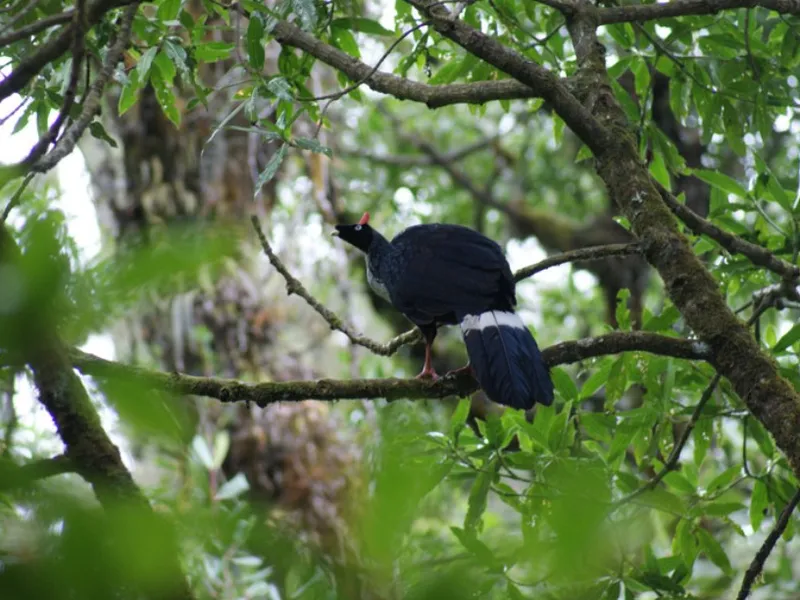
After the Cráter trail, the team moved to a second Horned Guan site on Renée's recommendation, approaching via a bamboo-covered back route and spending time waiting in the forest in complete silence. The patience paid off. Two Horned Guans emerged from the undergrowth and moved slowly along a fallen trunk before gliding into the forest. The team followed carefully and obtained extended views of both birds.
The Horned Guan is a bird that demands patience and commands respect. Its movements are slow and deliberate. It flies in complete silence. The red horn and feet stand out starkly in the muted grey-green of the cloud forest. After a full day on the mountain, it was an extraordinary reward.
As the team descended that evening, Buffy-crowned Wood-Partridge were heard calling from the forest, and the Fulvous Owl was back at its regular spot outside Renée's house.
| Species | Count | Location | Notes |
|---|---|---|---|
| ★★ Horned Guan | 2 | Chiquihuites forest | Extended views; the primary target |
| ★★ Black-capped Siskin | 23 | Camino al Cráter | Peak count on alder; likely the best site in Mexico |
| ★ Pink-headed Warbler | 5 | Chiquihuites and Crater trail | Excellent views at both sites |
| ★ Buffy-crowned Wood-Partridge | 2 | Chiquihuites | Heard calling on descent |
| ★ Wine-throated Hummingbird | 1 | Chiquihuites | Chiapas-Guatemala endemic |
| ★ Garnet-throated Hummingbird | 3 | Chiquihuites | With Amethyst-throated Mountain-gem at the same site |
| ★ Mountain Thrush | 3 | Chiquihuites | Restricted Mexican range |
| ★ Ruddy-capped Nightingale-Thrush | 3 | Chiquihuites | Singing from forest edge at dawn |
| ★ Black-throated Jay | 5 | Camino al Cráter | Confiding views on upper trail |
| ★ Broad-tailed Hummingbird | 2 | Chiquihuites and Crater trail | Disjunct resident population beyond normal range |
| Highland Guan | 4 | Chiquihuites | Pre-dawn and morning sessions |
| Amethyst-throated Mountain-gem | 5 | Chiquihuites | |
| Singing Quail | 1 | Chiquihuites | Heard in dense understorey |
| Golden-browed Warbler | 1 | Chiquihuites | |
| Crescent-chested Warbler | 3 | Chiquihuites and Crater trail | |
| Mountain Trogon | 2 | Chiquihuites | |
| Northern Emerald-Toucanet | 6 | Chiquihuites | |
| Brown-backed Solitaire | 10 | Multiple sites | |
| Rufous-collared Robin | 1 | Chiquihuites | |
| ★ Blue-and-white Mockingbird | 3 | Chiquihuites | |
| White-eared Hummingbird | 2 | Chiquihuites | |
| Fulvous Owl | 2 | Chiquihuites | Pre-dawn and evening |
| Mexican Violetear | 7 | Multiple sites | |
| Hutton's Vireo | 1 | Chiquihuites and Crater trail | |
| Common Chlorospingus | 11 | Multiple sites | |
| Steller's Jay | 2 | Camino al Cráter | |
| Yellow-eyed Junco | 3 | Camino al Cráter | |
| Brown Creeper | 1 | Camino al Cráter | |
| Bushtit | 8 | Camino al Cráter | |
| Tufted Flycatcher | 1 | Camino al Cráter | |
| Band-tailed Pigeon | 1 | Camino al Cráter | |
| Spotted Towhee | 1 | Camino al Cráter |
Day 3 (1 Dec): Camino Talquián Descent
Habitat: Cloud forest descent to lower foothill forest
Altitude: ~2,300 m descending to ~1,000 m
The return journey down the Camino Talquián on 1 December produced a noticeably different character of birding as altitude dropped and pine forest gave way to broader-leaf lower forest. Two Sparkling-tailed Hummingbirds, a pair of lekking males, gave exceptional views along the upper descent section. Both Blue-tailed Hummingbird and Azure-crowned Hummingbird appeared on the lower trail, with the Blue-tailed being a Pacific slope near-endemic with a restricted range that is easy to miss if focus remains on upper-mountain targets. Hooded Grosbeak gave excellent views. Red-legged Honeycreeper and Yellow-backed Oriole appeared in the same lower forest section, a signal of how rapidly the avifauna changes with descending altitude here.
Passing through Talquián village, a Black-capped Swallow was picked up overhead. This is a near-endemic with a small range centred on highland Guatemala and adjacent Chiapas, and a species routinely missed on Tacaná trips that focus entirely on the upper mountain without making it down to the village.
| Species | Notes |
|---|---|
| ★ Sparkling-tailed Hummingbird | Two lekking males; exceptional views on the upper descent |
| ★ Black-capped Swallow | Talquián village; near-endemic, routinely missed |
| ★ Blue-tailed Hummingbird | Lower trail; Pacific slope near-endemic |
| ★ Azure-crowned Hummingbird | Lower trail |
| ★ Hooded Grosbeak | Excellent views on descent |
| Rivoli's Hummingbird | High canopy |
| Red-legged Honeycreeper | Lower forest |
| Yellow-backed Oriole | |
| Baltimore Oriole | Talquián village |
| Elegant Euphonia | |
| Green Jay | |
| Black-headed Saltator | Conspicuous throughout the descent |
| Rose-breasted Grosbeak | |
| Yellow-winged Tanager | |
| Melodious Blackbird | |
| Southern House Wren | |
| Cabanis's Wren | Talquián village |
| Clay-colored Thrush | |
| Common Tody-Flycatcher | |
| Boat-billed Flycatcher | |
| Dusky-capped Flycatcher | |
| White-tipped Dove | |
| Band-backed Wren |
Species Highlights
- Horned Guan — 2 birds, 30 Nov, Chiquihuites forest (~2,500 m). The primary target. Extended views after a full day's approach. One of the most range-restricted cracids in the world, confined to a handful of highland cloud forest sites in Chiapas and Guatemala. Renée's knowledge of the specific sites and timing is essential here.
- Stygian Owl — Heard, 28 Nov, Chiquihuites. One of only two confirmed records in Chiapas since 1987. The other was also a Cardellina record, from Montebello Lakes earlier in 2025. An extremely scarce bird in Mexico.
- Unspotted Saw-whet Owl — Heard, 28 Nov, Chiquihuites. Among the most sought-after owls in the world. Confined to a handful of cloud forest fragments across southern Mexico and Guatemala, it is regularly described as one of the hardest Mexican owls to connect with. Finding it on arrival evening was a remarkable result.
- Fulvous Owl — Heard and seen, 28 Nov and 30 Nov, Chiquihuites. All three owl species in a single arrival evening session is an exceptional outcome.
- Black-capped Siskin — Peak count of 23 birds, 30 Nov, Camino al Cráter. Almost certainly the most reliable and productive site for this species anywhere in Mexico. Found feeding on mature alder; an extreme range-specialist with a distribution centred on this corner of the Mexico-Guatemala border.
- Horned Guan aside, the Broad-tailed Hummingbird at Tacaná represents one of the more intriguing biogeographic puzzles at the site. Its standard migratory range barely reaches Oaxaca, yet here it functions as a year-round resident in a population that is poorly documented and not well understood.
- Sparkling-tailed Hummingbird — 2 birds, 1 Dec, upper Camino Talquián. Two lekking males giving exceptional views on the descent. One of the most visually striking hummingbirds of the Chiapas highlands.
- Pink-headed Warbler — 5 birds total, 30 Nov, at both Chiquihuites and the Crater trail. A Mexican and Guatemalan endemic and one of the most visually distinctive warblers in the Americas. Excellent views at both sites on the same day.
- Wine-throated Hummingbird — 1 bird, 30 Nov, Chiquihuites. A Chiapas-Guatemala endemic with a limited range.
- Garnet-throated Hummingbird — 3 birds, 30 Nov, Chiquihuites. One of the larger and more spectacular of the highland hummingbirds, seen alongside Amethyst-throated Mountain-gem at the same site.
- Buffy-crowned Wood-Partridge — 2 birds heard, 30 Nov, Chiquihuites forest. Secretive and easily missed without local knowledge of the territory.
- Chestnut-sided Shrike-Vireo — Recorded on the Camino trail (29 Nov) and at Chiquihuites (30 Nov). One of the harder-to-find cloud forest specialties; located by call on both occasions.
- Blue-tailed Hummingbird — 3 birds, 1 Dec, lower Camino trail. A Pacific slope near-endemic with a restricted range, easy to miss if the focus remains on upper-mountain targets.
- Black-capped Swallow — 1 bird, 1 Dec, Talquián village. A near-endemic with a small range in highland Guatemala and adjacent Chiapas. Worth a specific look on any Tacaná descent that reaches village level.
- Guatemalan Tyrannulet — Multiple birds across both trail days. A genuine highland endemic, easily overlooked without prior knowledge of its call.
- Middle American Leaftosser — 1 bird, 29 Nov, Camino trail. An understorey skulker; detected by call and tracked to a satisfying view in the leaf litter.
- Blue-crowned Chlorophonia — 6 birds total across multiple sessions. Located readily by call; views dependent on cloud forest conditions at the time.
- Mountain Thrush — 3 birds, 30 Nov, Chiquihuites. An often-overlooked species with a notably restricted range in Mexico, confined to highland cloud forests of Chiapas and adjacent Guatemala.
- Blue-throated Motmot — Present across multiple days and sites. The deep kul-kul call is one of the defining sounds of the Tacaná cloud forest.
- Hooded Grosbeak — 1 bird, 1 Dec, lower Camino trail. A handsome species that marks the transition to broader-leaf lower forest on the descent.
- Highland Guan — 4 birds total at Chiquihuites, showing well on pre-dawn and morning sessions.
- Blue-and-white Mockingbird — Recorded across multiple sites and days. A striking endemic mockingbird of the Mesoamerican highlands.
- Golden-browed Warbler — 1 bird, 30 Nov, Chiquihuites. A localised highland resident warbler.
- Green-throated Mountain-gem — Multiple birds along mid-elevation sections of the Camino trail. A reliable highland hummingbird at this site.
- Azure-crowned Hummingbird — 1 bird, 1 Dec, lower Camino trail. A quality addition to the descent list.
Full Species List
94 species recorded across 4 days, 28 November – 1 December 2025. ★ = notable highlight.
| Species | Date first recorded | Location |
|---|---|---|
| Lesser Yellow-headed Vulture | 28 Nov | Consuelo Ulapa (en route) |
| Turkey Vulture | 29 Nov | Camino Talquián |
| Black Vulture | 29 Nov | Camino Talquián |
| Zone-tailed Hawk | 29 Nov | Camino Talquián |
| ★ Horned Guan | 30 Nov | Chiquihuites forest |
| ★ Highland Guan | 30 Nov | Chiquihuites |
| ★ Buffy-crowned Wood-Partridge | 30 Nov | Chiquihuites |
| Singing Quail | 30 Nov | Chiquihuites |
| Band-tailed Pigeon | 30 Nov | Camino al Cráter |
| White-tipped Dove | 1 Dec | Camino Talquián |
| Inca Dove | 30 Nov | Camino al Cráter |
| ★ Stygian Owl | 28 Nov | Chiquihuites |
| ★ Fulvous Owl | 28 Nov | Chiquihuites |
| ★ Unspotted Saw-whet Owl | 28 Nov | Chiquihuites |
| Mexican Whip-poor-will | 28 Nov | Chiquihuites |
| ★ Broad-tailed Hummingbird | 30 Nov | Chiquihuites |
| ★ Sparkling-tailed Hummingbird | 1 Dec | Camino Talquián |
| Mexican Violetear | 28 Nov | Multiple sites |
| Violet Sabrewing | 29 Nov | Camino Talquián |
| Rivoli's Hummingbird | 1 Dec | Camino Talquián |
| ★ Garnet-throated Hummingbird | 30 Nov | Chiquihuites |
| Amethyst-throated Mountain-gem | 30 Nov | Chiquihuites |
| ★ Green-throated Mountain-gem | 29 Nov | Camino Talquián |
| ★ Wine-throated Hummingbird | 30 Nov | Chiquihuites |
| ★ Blue-tailed Hummingbird | 1 Dec | Camino Talquián (lower) |
| ★ Azure-crowned Hummingbird | 1 Dec | Camino Talquián |
| White-eared Hummingbird | 30 Nov | Chiquihuites |
| Ruby-throated Hummingbird | 28 Nov | Multiple sites |
| ★ Blue-throated Motmot | 28 Nov | Multiple sites |
| Mountain Trogon | 29 Nov | Camino Talquián |
| Northern Emerald-Toucanet | 29 Nov | Multiple sites |
| Golden-olive Woodpecker | 29 Nov | Camino Talquián |
| Hairy Woodpecker | 29 Nov | Camino Talquián |
| ★ Middle American Leaftosser | 29 Nov | Camino Talquián |
| ★ Scaly-throated Foliage-gleaner | 29 Nov | Camino Talquián |
| ★ Ruddy Foliage-gleaner | 29 Nov | Camino Talquián |
| Spot-crowned Woodcreeper | 29 Nov | Camino Talquián |
| ★ Guatemalan Tyrannulet | 29 Nov | Multiple sites |
| Tufted Flycatcher | 30 Nov | Camino al Cráter |
| Greater Pewee | 29 Nov | Multiple sites |
| Yellowish Flycatcher | 29 Nov | Multiple sites |
| Eye-ringed Flatbill | 29 Nov | Camino Talquián |
| Common Tody-Flycatcher | 1 Dec | Camino Talquián |
| Boat-billed Flycatcher | 1 Dec | Camino Talquián |
| Dusky-capped Flycatcher | 1 Dec | Multiple sites |
| ★ Gray-collared Becard | 29 Nov | Camino Talquián |
| Rose-throated Becard | 29 Nov | Multiple sites |
| ★ Chestnut-sided Shrike-Vireo | 29 Nov | Multiple sites |
| ★ Brown-capped Vireo | 28 Nov | Multiple sites |
| Blue-headed Vireo | 29 Nov | Camino Talquián |
| Hutton's Vireo | 30 Nov | Multiple sites |
| ★ Black-capped Swallow | 1 Dec | Talquián village |
| Violet-green Swallow | 28 Nov | Chiquihuites |
| Bushtit | 30 Nov | Camino al Cráter |
| Brown Creeper | 30 Nov | Camino al Cráter |
| Band-backed Wren | 29 Nov | Multiple sites |
| Gray-breasted Wood-Wren | 28 Nov | Multiple sites |
| Spot-breasted Wren | 29 Nov | Camino Talquián |
| Southern House Wren | 1 Dec | Camino Talquián |
| Cabanis's Wren | 1 Dec | Talquián village |
| ★ Ruddy-capped Nightingale-Thrush | 30 Nov | Chiquihuites |
| Brown-backed Solitaire | 29 Nov | Multiple sites |
| ★ Mountain Thrush | 30 Nov | Chiquihuites |
| Rufous-collared Robin | 30 Nov | Chiquihuites |
| Clay-colored Thrush | 1 Dec | Camino Talquián |
| ★ Blue-and-white Mockingbird | 29 Nov | Multiple sites |
| Gray Catbird | 28 Nov | Multiple sites |
| Gray Silky-flycatcher | 30 Nov | Chiquihuites |
| Cinnamon-bellied Flowerpiercer | 29 Nov | Camino Talquián |
| ★ Black-capped Siskin | 30 Nov | Camino al Cráter |
| Yellow-eyed Junco | 30 Nov | Camino al Cráter |
| Spotted Towhee | 30 Nov | Camino al Cráter |
| Chestnut-capped Brushfinch | 29 Nov | Camino Talquián |
| Common Chlorospingus | 29 Nov | Abundant throughout |
| ★ Pink-headed Warbler | 30 Nov | Chiquihuites and Camino al Cráter |
| ★ Blue-winged Warbler | 29 Nov | Camino Talquián |
| ★ Golden-winged Warbler | 29 Nov | Camino Talquián |
| Tennessee Warbler | 29 Nov | Multiple sites |
| Nashville Warbler | 28 Nov | Multiple sites |
| MacGillivray's Warbler | 29 Nov | Multiple sites |
| Wilson's Warbler | 29 Nov | Multiple sites |
| Black-and-white Warbler | 29 Nov | Multiple sites |
| Townsend's Warbler | 29 Nov | Multiple sites |
| Blackburnian Warbler | 29 Nov | Camino Talquián |
| Slate-throated Redstart | 29 Nov | Camino Talquián |
| ★ Golden-browed Warbler | 30 Nov | Chiquihuites |
| Golden-crowned Warbler | 29 Nov | Camino Talquián |
| Rufous-capped Warbler | 28 Nov | Multiple sites |
| Crescent-chested Warbler | 30 Nov | Multiple sites |
| ★ Blue-crowned Chlorophonia | 29 Nov | Camino Talquián |
| Elegant Euphonia | 1 Dec | Camino Talquián |
| Western Tanager | 29 Nov | Multiple sites |
| Summer Tanager | 29 Nov | Camino Talquián |
| Flame-colored Tanager | 28 Nov | Multiple sites |
| Yellow-winged Tanager | 1 Dec | Camino Talquián |
| Red-legged Honeycreeper | 1 Dec | Camino Talquián |
| ★ Hooded Grosbeak | 1 Dec | Camino Talquián (lower) |
| Rose-breasted Grosbeak | 1 Dec | Camino Talquián |
| Black-headed Saltator | 1 Dec | Camino Talquián |
| Melodious Blackbird | 28 Nov | Multiple sites |
| Great-tailed Grackle | 1 Dec | Camino Talquián |
| Baltimore Oriole | 1 Dec | Talquián village |
| Yellow-backed Oriole | 1 Dec | Camino Talquián |
| Green Jay | 1 Dec | Camino Talquián |
| ★ Black-throated Jay | 30 Nov | Camino al Cráter |
| Steller's Jay | 30 Nov | Camino al Cráter |
Final Thoughts
Tacaná is not easy birding. The terrain is demanding, the cloud forest dense, and the Horned Guan is precisely as difficult as its reputation suggests. Renée's knowledge of this mountain and its birds, built across years of daily presence here, is the difference between going home empty-handed and watching one of the most unusual birds in the Americas step out of the mist in front of you.
94 species across four days, including three owl species in a single arrival evening, the most reliable Black-capped Siskin site in Mexico, and both Pink-headed Warbler and Horned Guan on the same day. A site that consistently rewards those willing to put in the effort.
To join a Cardellina trip to Tacaná or elsewhere in Chiapas, visit cardellina.com or get in touch directly.