
Pink-headed Warbler
Cardellina versicolor · Chiapas, Mexico
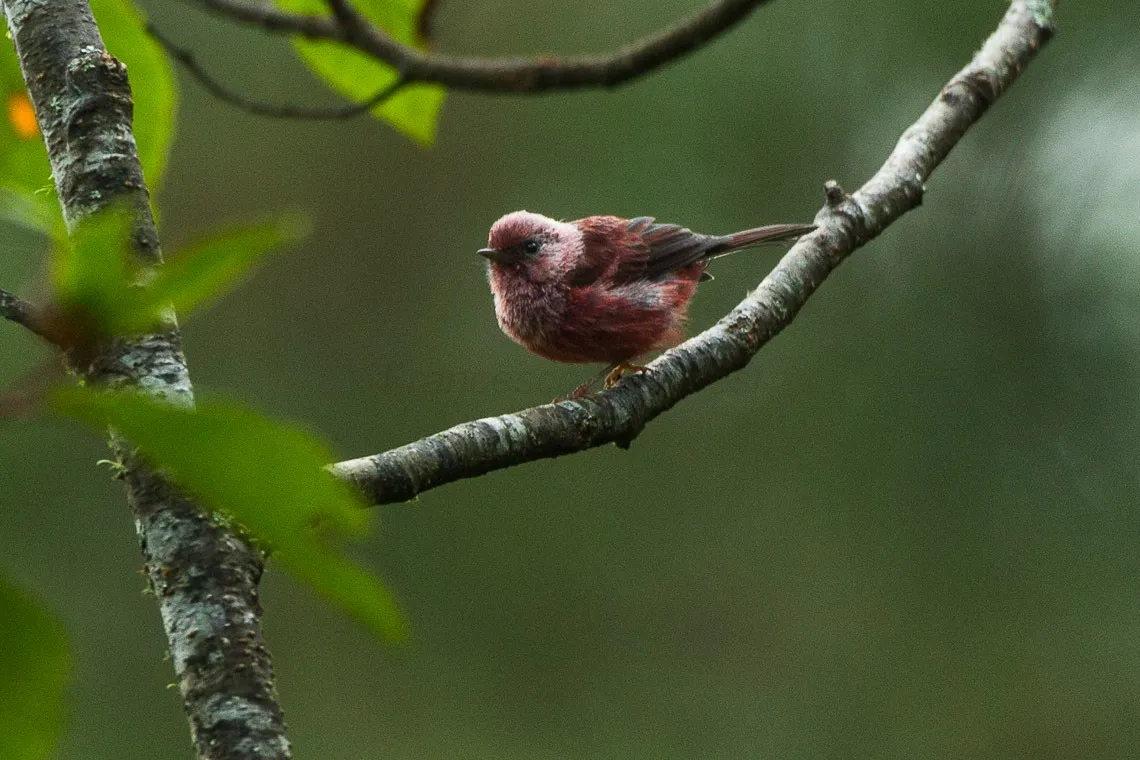
| Scientific name | Cardellina versicolor |
| Conservation status | Vulnerable (IUCN) Endangered in Mexico |
| Range | Chiapas, Mexico & highlands of Guatemala |
| Elevation | 1,800 m – 3,500 m |
| Best months | Year-round; most vocal February – May |
| Difficulty | Moderate — reliable with a local guide |
The Pink-headed Warbler is one of Chiapas's most sought-after birds, a deep red and rose-pink warbler found only in the state's high-altitude cloud forests, between 1,800 m and 3,500 m, and nowhere else in Mexico. Classified as Vulnerable by the IUCN and Endangered under Mexican law, its range has been steadily eroded by the loss of montane forest. Much of the habitat it depends on falls within traditional Tzotzil and Tzeltal indigenous lands, meaning that finding this species reliably requires not just field knowledge, but genuine local relationships.
Identification
In its range, the Pink-headed Warbler is essentially unmistakable. No other bird in the highland forests of Chiapas has that extraordinary silvery-rose head and chest. Both sexes share the same plumage. Juveniles are a rich brown with pink and red flecks, but moult quickly.
Distribution and habitat
The Pink-headed Warbler occurs in just two countries: the highlands of Chiapas in southern Mexico, known locally as Los Altos de Chiapas, and the high-elevation mountain forests of Guatemala. Its global range covers approximately 52,900 km²,1 making it one of the more range-restricted warblers in the Americas. Within Chiapas, the most reliable sites are the forests surrounding San Cristóbal de Las Casas and the upper slopes of Tacaná Volcano, where the species reaches the western limit of its range.
A pine-oak-alder specialist, it favours open forest with mature pines overhead and dense low shrub beneath, a habitat under sustained pressure from agricultural expansion and charcoal production. The eruption of Volcán Chichonal in 1982 is thought to have compounded historical declines, with ash fallout destroying a significant portion of suitable highland forest in the years that followed.
Seasonality and finding the species
The Pink-headed Warbler is a year-round resident, showing strong site fidelity and rarely straying far from established territories. Males begin singing from early February, with activity peaking between March and May before going largely silent during the wetter months of June onwards. Outside the breeding season, the sharp metallic chip call is the most reliable indicator of its presence — loud, proud, and carrying well through dense understorey. This is not a particularly shy species, and once located it will often allow close approach.
The nesting season runs from March to May.3 The female builds a domed nest directly on the ground from Pinus ayacahuite needles, typically on a slope. We have observed nesting pairs in the Montetik Nature Reserve and on private reserves near San Cristóbal de Las Casas — a photograph of a nest with chicks from the region is available on iNaturalist. Juveniles are typically on the wing from late April, a particularly rewarding time to visit.
Conservation
With an estimated global population of between 13,000 and 33,000 mature individuals, and numbers declining, the Pink-headed Warbler's future depends on what happens to the cloud forests of Chiapas and Guatemala over the next few decades.1
The Pink-headed Warbler is a target species on our San Cristóbal highlands day tour, and a key draw on multi-day bespoke itineraries to Tacaná Volcano.
See our Chiapas birding toursSources
- BirdLife International (2024). Species factsheet: Pink-headed Warbler Cardellina versicolor. datazone.birdlife.org
- Billerman, S. M. et al. (eds.) (2022). Birds of the World: Pink-headed Warbler. Cornell Lab of Ornithology. birdsoftheworld.org
- Quinonez-Guzman, J. M., Bosarreyes, B. & Orozco Diaz, E. (2021). Notes on nests of the Pink-headed Warbler (Cardellina versicolor), with observations on parental behavior. Huitzil 22(2), e621. doi.org/10.28947/hrmo.2021.22.2.544