
Rose-bellied Bunting
Passerina rositae · Isthmus of Tehuantepec, Mexico
| Scientific name | Passerina rositae |
| Conservation status | Near Threatened (IUCN) Threatened in Mexico |
| Range | Mexican endemic. Isthmus of Tehuantepec: southeastern Oaxaca and southwestern Chiapas |
| Elevation | 150 m – 800 m |
| Best months | Resident year-round; easiest in the dry season, roughly November – May |
| Difficulty | Easy at the right site, but the range is tiny, so getting there is the hard part |
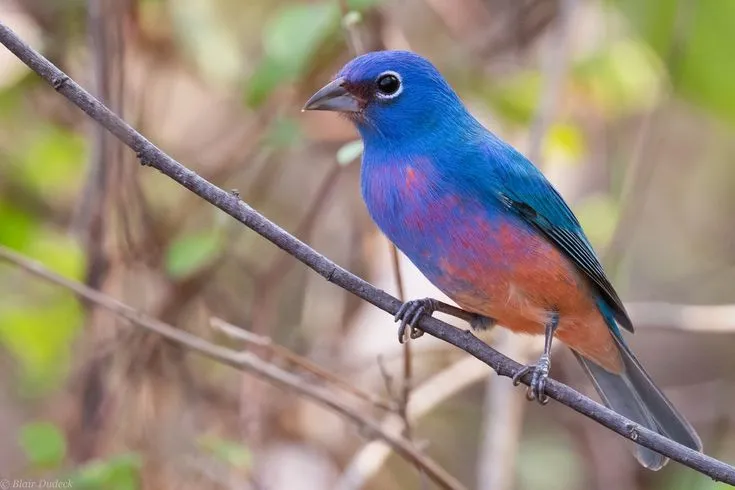
A micro-endemic species found exclusively in the La Sepultura Reserve of Chiapas and neighbouring Oaxaca at the Sierra Tolistoque, the Rose-bellied Bunting's stunning pastel-like blue and rose plumage are one of the most memorable sights in all of birding in Mexico, with a lovely story behind its discovery.
This species was formerly known as Rosita's Bunting, a reference still maintained in the scientific name Passerina rositae. The first collector of this species was François Sumichrast, a Swiss naturalist who moved to Mexico in the 1850s. His love for his adoptive country was cemented upon meeting his beautiful wife (as says his contemporary colleague G. N. Lawrence), Rosalía ("Rosita") Nivón. The bird was named in reference to her, and his daughter, also named Rosita.1
Identification
The male's rose belly blended with pastel-blue upperparts and neat white eyering is unmistakeable. The female could potentially be confused with a female Orange-breasted Bunting, though there is just a small overlap in their range. The female Orange-breasted Bunting is slightly pale yellow and has a pale yellow eyering, as opposed to the Rose-bellied Bunting's slightly duller oakier tones with a pale cream eyering.
Distribution and habitat
Deciduous dry forests and thorn forests of the Isthmus of Tehuantepec, along with moister gallery and swamp forest in the hillier parts of its range, between 150 m and 800 m.3 The bird appears to have a preference for well-preserved areas with exposed limestone rock. The use of the highly-threatened Beaucarnea recurvata leaves for nesting material suggests this may be a key to finding the species.4
Seasonality and finding the species
A year-round resident, and far easier to find during the dry season, roughly November to May, when the bird's bright colouration stands out plainly against deserted backgrounds. Once the deciduous forest leafs out with the rains, the same birds become considerably harder work. Nesting has been recorded in late June and late July, at the start of the wet season.4
Conservation
Highly threatened as a result of extensive wind-farm projects within the bird's range. The IUCN lists the species as Near Threatened on account of its very small range and the likelihood of decline through habitat degradation and infrastructure development, while Mexican legislation classifies it as threatened.3
The Rose-bellied Bunting is the flagship target on our La Sepultura day tour, and features on our longer trips through the Pacific slope.
See our Chiapas birding toursSources
- Boucard, A. (1884). Notice sur François Sumichrast. Bulletin de la Société Zoologique de France 9: 305–312. books.google.com
- Lobato García, J. A. ("ElChivizcoyo"), Raty, L., Bergenholtz, B. et al. (2016). About the name of Passerina rositae. BirdForum discussion thread, in which Rosita was identified as Rosalía Nivón. birdforum.net
- BirdLife International (2024). Species factsheet: Rose-bellied Bunting Passerina rositae. datazone.birdlife.org
- Monroy-Ojeda, A., Grosselet, M. & Ruiz, G. (2013). Further contributions on the description of the nest, eggs and nesting habitat of the Mexican micro-endemic and near threatened Rose-bellied Bunting (Passerina rositae). Huitzil 14(2). scielo.org.mx
- Lawrence, G. N. (1874). Description of Cyanospiza rositae. Annals of the Lyceum of Natural History of New York 10: 397. biodiversitylibrary.org